


Silkscreen Printing

single color process
WI State Standards:
- AA Cr11h
Plan: Formulate original concepts by practice, experimentation, and revision. (planning/experimentation) - AA Cr12h
Make: Create works of art that introduce students to media, care of tools, and basic craftsmanship skills.
(skills) - AA Pr10h
Develop Meaning: Curate a body of work incorporating personal, historical and contemporary art to communicate one or more points of view.
(aesthetics / communication)
Learning targets
- learn the silkscreen printing process
- design a unique image to match the requirements for printing
- print one-color sheets
- experiment with multi-color and other media
Screen printing is a printmaking technique that creates a sharp-edged image using a stencil.
Stencil is made by exposing stretched silk, covered with photo emulsion, to light.
A screen is made of silk or polyester. It is stretched over a frame of aluminum or wood. Areas of the screen are blocked off with a non-permeable material to form a stencil, which is a negative of the image to be printed; that is, the open spaces are where the ink will appear.
The screen is placed atop paper or fabric. Ink is placed on top of the screen, and a squeegee is used to fill the mesh openings with ink.
quick steps
- Draw a design. Use black&white imaging only (lines, solid black shapes, shadings: pointillism, hatching, cross-hatching)
- Transfer the design onto 2 sheets of transparency, tape them together for better light block.
- Stretch a piece of silk (or polyester mesh) over a frame.
- Apply photo-emulsion. Dry.
- Place the transparency onto the frame and expose to light (to solidify exposed areas and block the drawn areas)
- Rinse the silk to reveal the stencil. Dry.
- Place the frame over a printing surface and squeeze ink through the stencil.
STEPS:

Start with a drawing. There should be no shading in your drawing.
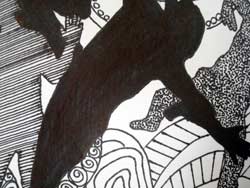
Use pointillism, crosshatching or other techniques to show values:
Outline everything with a Sharpie.
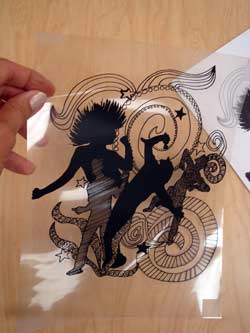
Two copies on transparency sheets should be made.
Align them and tape with a clear tape.
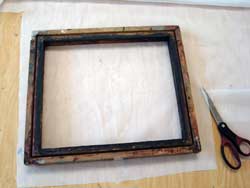
Next step is to stretch the silk on a frame.
Cut a piece of silk that is larger than the frame by about 2" on all four sides.
Place it on top of the frame.
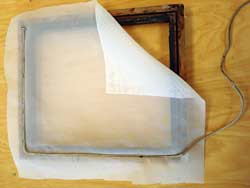
Lay the cord above the indent in the frame.
Push it in with your fingers.
Make sure there are no wrinkles on the silk and it is stretched tightly.
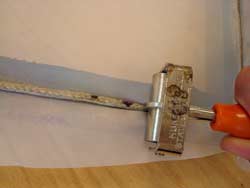
Use a cord roller to push the cord in.
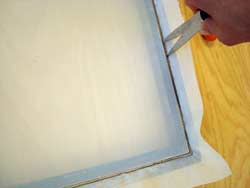
Then use scissors or a screwdriver to further push the cord in.
It should be as tight as a drum…….
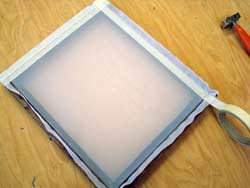
Cut the excess silk.
Use masking tape to cover the cord.
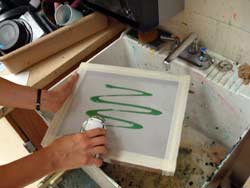
Now that the screen is ready – time to apply the photo emulsion. Keep in mind that it is light sensitive.
Over a sink, apply some emulsion over the screen.
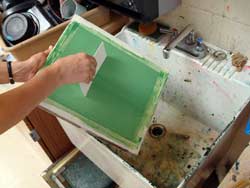
Use a squeegee to distribute the emulsion evenly over the screen.
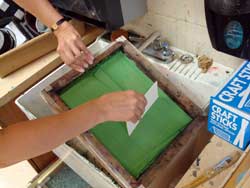
Flip the screen and use squeegee again.
The idea is to push the emulsion through the fabric’s pores and have a solid thin layer of the emulsion. It should be of a uniform consistency with no dripping marks.
Take it to a dark room and let it dry.
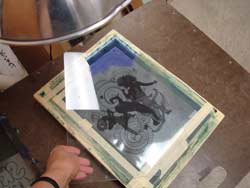
Time to transfer your drawing onto the screen.
Place the screen on a table in a dark room
Place the transparencies (mirror image) on top.
Place a piece of glass over it to hold the transparencies close to the screen.
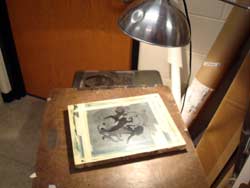
Turn on the light above the screen.
IMPORTANT: Timing is really important. Note time when you exposed the screen to the light. It should take between 12 to 15 minutes before you turn the light off.
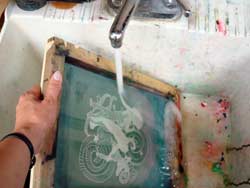
Take the screen to a sink.
Turn on cold water. Wash the screen on both sides.
First, you’ll see how your drawing is appearing on the screen
Keep washing. You need to see light through the drawing:
Let it dry.
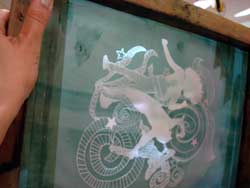
Now you are ready to print!