


Object Concentration
WI State Standards:
- AA Cr11h
Plan: Formulate original concepts by practice, experimentation, and revision. (planning/experimentation) - AA Cr12h
Make: Create works of art that introduce students to media, care of tools, and basic craftsmanship skills.
(skills) - AA Pr10h
Develop meaning: Create s body of work incorporating personal, historical, and contemporary art to communicate one or morepoints of view.
(aesthetics / communication)
Learning objectives
- focusing on exploring a single object
- observational drawing, painting, printing, etc.
- planning and sketching
- exploring new media
- tonal value rendering
- light effects

In this project, you will create a series of six square artworks, each measuring 5” × 5”, all based on one object of your choice. The goal is to study a single object closely and represent it in different ways using a variety of materials, styles, and viewpoints.
Your object can be simple or everyday as long as it is school appropriate. Examples include fruit, candy, toys, shoes, tools, art supplies, candles, or household objects.
Project Requirements:
- Create 6 finished artworks
- Each piece must be 5” × 5” (square format)
- All pieces must feature the same object
- Each artwork should show variation through:
- Different media
- Different angles or viewpoints
- Different styles or levels of detail
- You may draw the entire object or focus on interesting details or sections
Required Media (one per square)
You must use all six of the following:
- Pencil or charcoal drawing. Focus on value shading and form.
- Linear drawing (thin Sharpie or pen & ink). Use contour lines, line weight, and detail. No shading with value
- Colored pencils. Focus on color layering, texture, and control.
- Watercolor paint. Explore transparency, washes, and soft transitions.
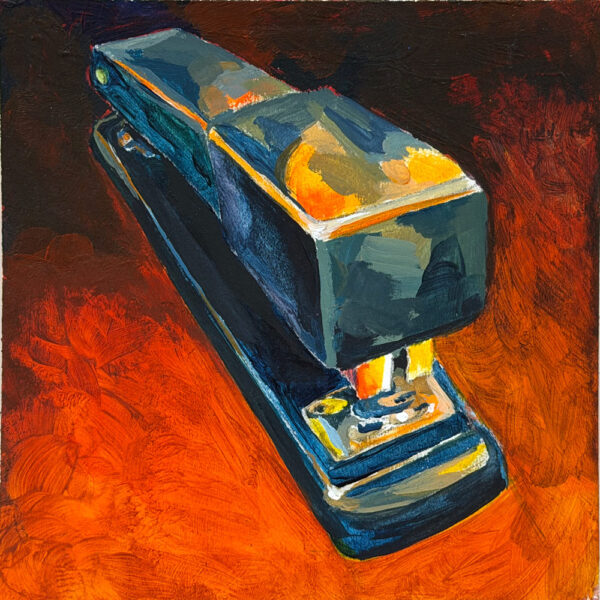
- Acrylic paint. Use opacity, brushwork, and bold color choices.
- White pencil on black board. Use reverse shading by building light and letting the black surface act as shadow
examples:


STEPS
Start with your sketchbook and draw the object from different views. Sketch at least 5 different versions.
Explore it – its form, proportions, colors, values, details, etc.
When you get familiar with the object – start working with a media (you choose the order).
1. Pencil or Charcoal – Value Study

Begin by lightly sketching the overall shape of your object using simple forms. Check proportions before adding any shading. Once the shape is correct, identify the light source and block in the main shadow areas. Gradually build values from light to dark using smooth shading. Focus on form, volume, and realistic light rather than small details.
2. Pen & Ink – Linear Drawing

Start with a light pencil sketch to plan placement and composition. Once ready, trace over your drawing using a thin Sharpie or pen. Use line weight, overlapping lines, and contour to describe the form. Avoid shading with value. Let lines do the work. Erase all pencil marks when finished.
3. Colored Pencil – Color & Texture

Begin with a light outline of your object. Build color slowly using light pressure and multiple layers. Pay attention to color changes caused by light and shadow. Blend colors through layering rather than pressing hard. Use directional strokes to suggest texture and surface quality.
4. Watercolor – Light & Washes

Lightly sketch your object in pencil, keeping lines simple. Start with light washes and build color gradually, allowing areas to dry between layers. Let the white of the paper act as highlights. Focus on transparency, soft edges, and smooth transitions rather than detail.
5. Acrylic – Shape & Opacity

Sketch the object lightly to plan composition. Block in large shapes first using thin layers of paint. Work from background to foreground and from dark to light. Use opacity to create strong contrast and bold color choices. Add details only after the main forms are established.
6. White Pencil on Black Board – Reverse Shading

Begin with a very light graphite sketch to place the object accurately. Start adding white pencil softly, building the brightest areas first. Use pressure control and layering to create gradual value changes. Allow the black surface to remain visible in shadow areas. Focus on light, texture, and form rather than outlines.
Purpose of the Project
This series will help you:
Improve observation and concentration
Understand how different materials affect style and mood
See how one object can be interpreted in many ways
Build technical skill across multiple media
All six squares should feel connected and work together as a set. When displayed, they should read as a cohesive series, not six unrelated drawings.