
COLOR SCHEMES


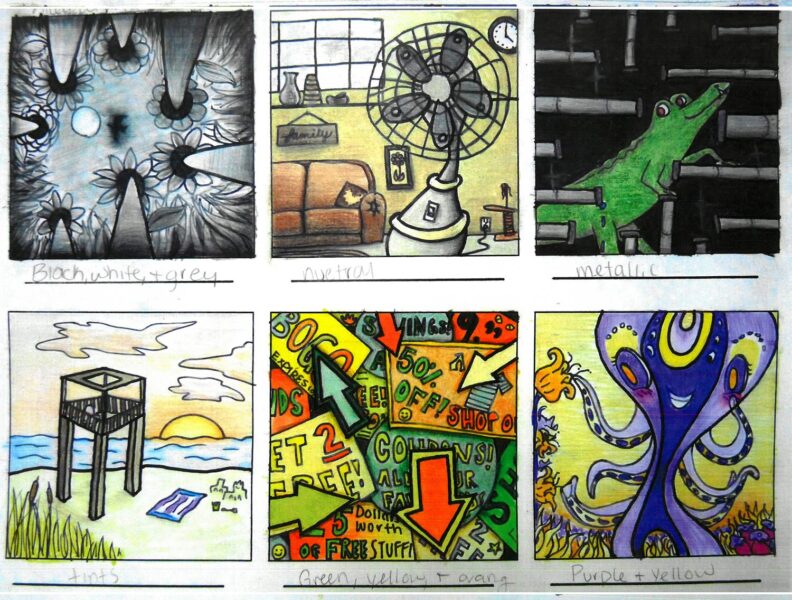
Random or irregular shapes and lines can stimulate your imaginative forces.
Print out the worksheets. What do you think is hidden within each square?
Use existing shapes and lines to incorporate them into a realistic and recognizable object/setting/ place/person.
Start with sketching your ideas.
Spend at least 2 class periods to plan your compositions. Make a decision on color schemes. Refresh your memory if you are not sure…
1. Standard AA Cr11h (planning/experimentation): Start with sketching. Analyze each line and shape. Look at them as a whole. Brainstorm for associations and sketh them out. Draw a thumbnail for each image. You can add color to your sketches if you wish to.
2. Standards AA Cr12h (skills): Then let’s focus on each individual drawing.
Do a line drawing first using regular pencil, drawing lightly so that you can easily erase. Take your time with this step.
Then use a fine point marker or a black rollerball pan to outline added lines. Try to make them blend seamlessly into existing lines.
Next – coloring. Use colored pencils to create volume and space in each drawing.
3. AAPr10h (aesthetics/communication): Make sure each image is fully colored or shaded and all values are rendered. Each image is realistic and representational.

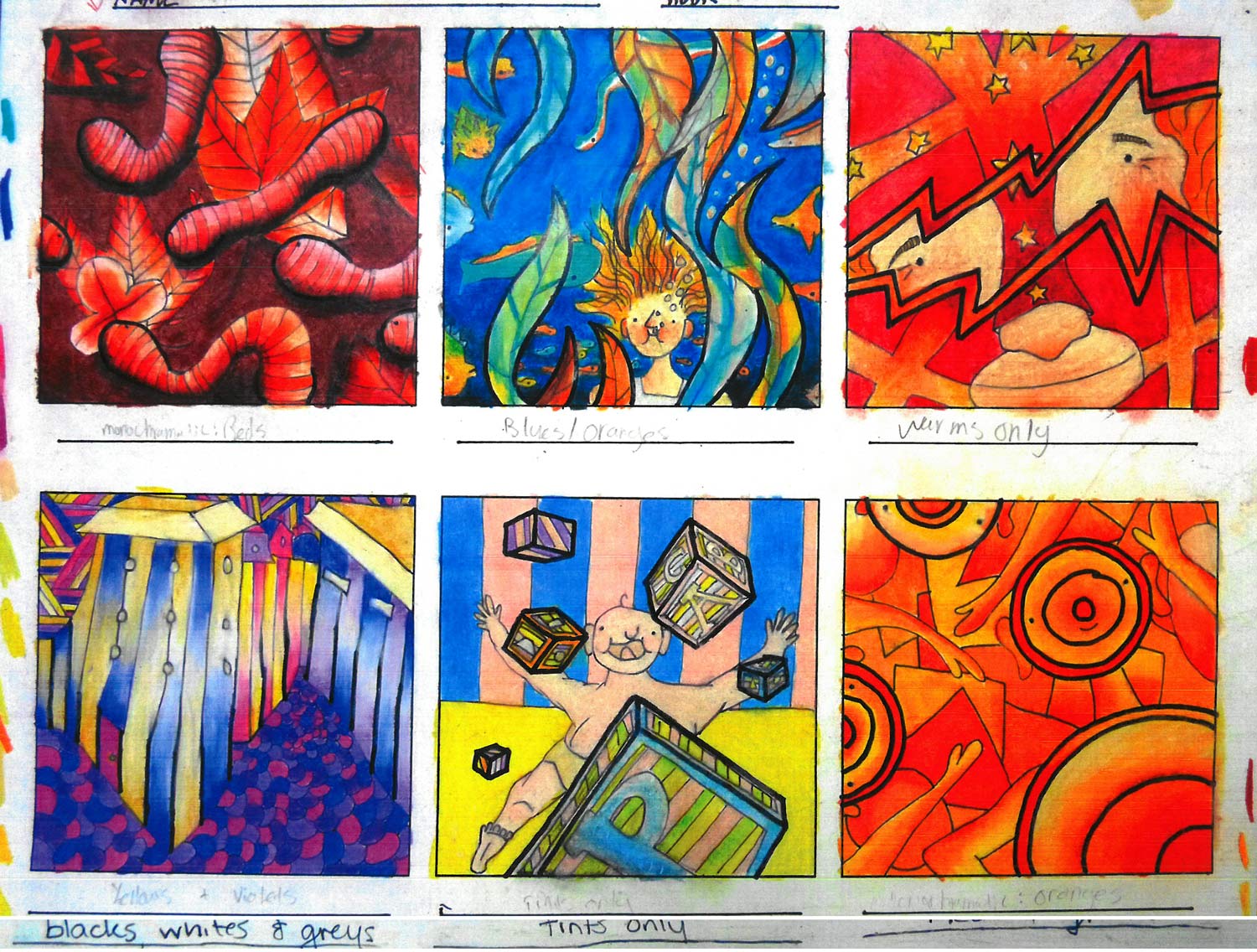


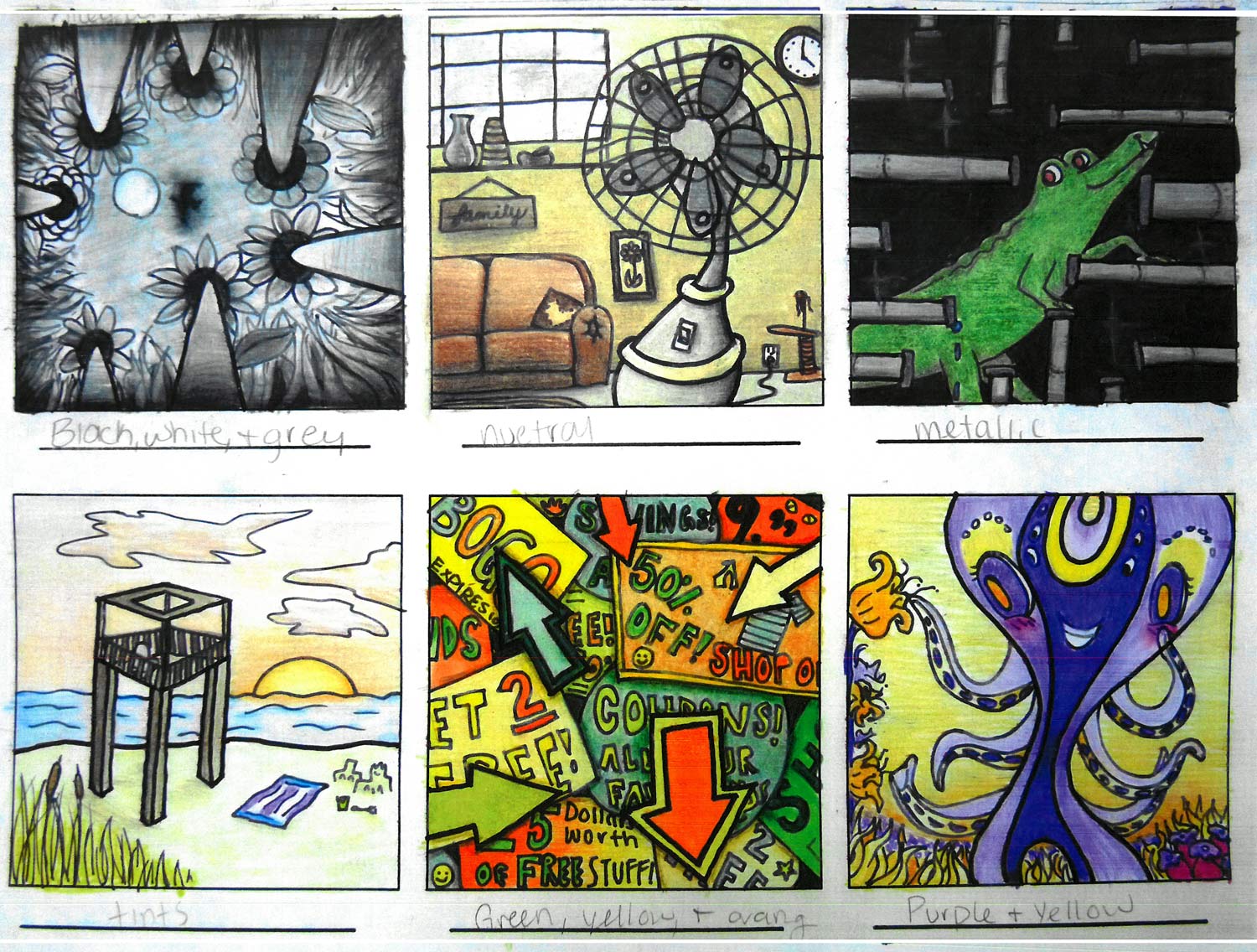


Treat each square as an independent artwork. Focus on one composition at a time. Analyze it. What it reminds you of? What does it look like?
Use existing shapes and lines to incorporate them into a realistic and recognizable object/setting/ place/person. All existing lines should be used. You can only add to the drawing, not subtract from it.
Sketch out your ideas. Review them and modify if needed.
You should have a comprehensive sketch for each of the six compositions.
Once you came up with an idea – execute it using a pencil and a fine-point marker (or a ball pen).
Carefully draw your additions to a composition with a pencil.
Outline it with a fine point marker or a black pen to match the existing lines.
Use colored pencils to color the drawings.
Each square should be colored using one of the following color schemes/options:
(use this link for color choices)
Coloring requirements:
| standard | no evidence | beginning | emerging | proficient | advanced |
|---|---|---|---|---|---|
|
Cr.11 planning / experimentation |
No preliminary sketches were made Assignment does not show enough evidence or is missing |
Some sketches were made. At least 3 drawings (out of 6) depict objective scenes |
Drawings are based on preliminary sketches All 6 drawings depict objective scenes |
Drawings are objective. Drawings incorporate the existing shapes and lines. Drawings are creative. |
Artwork demonstrates an extensive research and practice; Drawings are telling stories that have characters Drawings are detailed, Artwork is unique and creative. |
|
Cr.12 skills |
Assignment does not show enough evidence or is missing |
Drawings are colored |
Drawings are colored based on color schemes Coloring is solid, small strokes. |
Color schemes are labeled. Coloring is done according to the requirements: Craftsmanship |
Coloring is flawless, good color blending. 3D effect is achieved by utilizing the Chiaroscuro pattern. Craftsmanship and attention to details are flawless; |
|
Pr.10h aesthetics / communication (illusion of depth, personal involvement) |
Work is not complete and/or does not show the process from specified instructions or there is no evidence or is missing |
The artwork communicates little effort and personal emotional involvement in the process. Project is not finished No illusion of depth |
Student attempted to follow the directions. Project does not show enough creativity and effort Some areas need improvement. |
Artwork shows individuality and effort. The artwork displays a clear meaning and style of the assignment. Craftsmanship is good |
Student went above and beyond in the use of Art Elements and Principles to convey a clear message, showed understanding of the task, and solved the task in the most creative way. Artwork shows individuality and emotion involvement. Artwork is intricate. |