YouTube Video


In Color Theory, a color scheme is the choice of colors used in design for a range of media.
Color schemes are used to create style and appeal.
Color schemes contain a full range of values (tints, tones, and shades) of each hue.

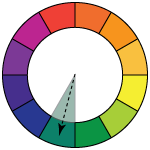
Variations of ONE color (+ tints, tones, shades)
Click on the image to view colors choices.
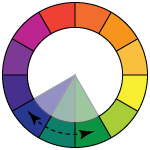
Variations of 3-4 colors that are next to each other.
Click on the image to view colors choices.
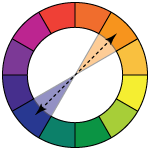
Variations of opposite colors.
Click on the image to view colors choices.
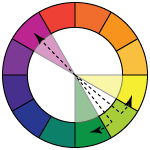
Variations of a color and its complement’s neighbors
Click on the image to view colors choices.
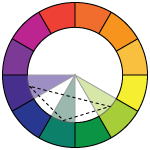
Three colors evenly spaced with one color in-between.
Click on the image to view colors choices.
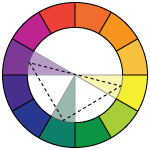
Three colors evenly spaced with two colors in-between.
Click on the image to view colors choices.
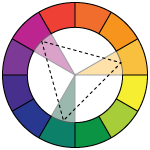
Three colors evenly spaced with three colors in-between.
Click on the image to view colors choices.
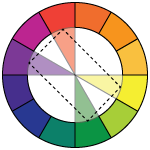
Two pairs of complementary colors – split by one color.
Click on the image to view colors choices.
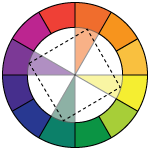
Two pairs of complementary colors evenly spaced (split by two).
Click on the image to view colors choices.

A color scheme is a set of colors in an artwork chosen by an artist. It describes the overall selection of colors.

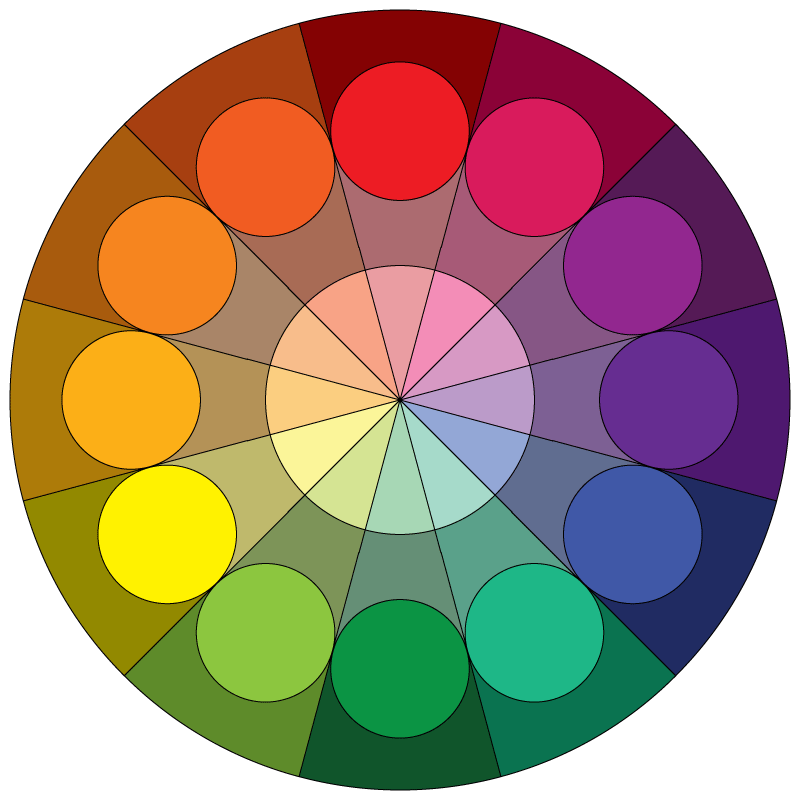
These color combinations are based on their position on the color wheel.

You can use other colors in your work, but use color schemes for dominant colors or emphasis.

When you are working with color schemes, you should consider using each color’s extended range.
This includes its shades, tints, and tones.
It will offer the eye some restful colors that have been lightened, darkened or neutralized. These variations also allow the more powerful saturated colors to be used more sparingly for emphasis when needed.

Achromatic – means “no color”.
Pure achromatic colors include black, white, all shades of grey and neutrals.
Black, white and grey work with all color schemes.
Tonal relationships help us make sense of what we see in the world around us. Our vision uses the contrast of value to determine one object from another.

The achromatic scheme is very harmonious .
It is subtle and quiet in nature. There can be some color present…but only if it is kept unsaturated.

Monochromatic colors are the colors of a single hue.
That includes all color values.

Monochromatic colors naturally create harmony.
This scheme looks clean and elegant.
Monochromatic colors go well together and produce a soothing effect. It is very easy on the eyes, especially with blue or green hues.
You can use it to establish an overall mood in an artwork.

Analogous colors are the colors that are next to each other on the color wheel.

Analogous colors are often found in nature and are pleasing to the eye.
Since analogous colors are located close to each other on the color wheel, it means that they are generally in the same family of colors.
This also means that the Color Scheme is automatically harmonious. In other words, it’s nearly impossible for the colors to clash.
But on the other hand, it can be a challenge to create enough variety. This means the results can be quite boring unless you make the most of your chosen color palette.
A good approach to working with analogous colors is to pick one as a dominant color, second as a supporting color, and the third one can be used as an accent.

Complementary colors are directly opposite each other on the Color Wheel.
Both look their best and brightest when they are placed next to each other.
When complementary colors are mixed – they create a neutral – brown.

The high contrast of complementary colors creates a vibrant look especially when used at full saturation.
Complementary colors intensify each other. In Color Theory this phenomenon is called Simultaneous Contrast.
You can take advantage of this to help create drama in your artwork.

A Split-complementary scheme is a variation of the complementary color scheme.
It involves the use of 3 colors.
Split-complementary colors are the opposite colors, where instead of one complementary color we use the two colors adjacent to it. Start with one color.
Find its complement.
Then choose the two colors next to it.

This scheme has very strong visual contrast ,like the complementary scheme, but it has less tension and drama.

Triadic colors are the 3 colors that form a triangle on the Color Wheel.
They are evenly spaced and can be separated, for example, by 3 hues.

This scheme would make a very bold statement.
Imagine using all primary colors in one painting.

Colors can also be separated by 2 hues

Triadic colors tend to be quite vibrant.
You need to balance them carefully to achieve harmony.

Triadic colors can also be separated by only one hue.

Use colors in different proportions.
At least one of them should be used as an accent color.
A good approach is to use one as dominant color, and the other two use for accents.

The tetradic color scheme uses 4 colors arranged into two complementary pairs.
It is also called the Double-complementary color scheme.
This scheme offers plenty of possibilities for variation.

The tetradic color scheme works best if you let one color be dominant.
You should also pay attention to the balance between warm and cool colors.
This scheme is hard to pull off, but when it is done correctly – the colors become mesmerizing

This color scheme is similar to a rectangle, but with all 4 colors spaced evenly around the color wheel.

These color combinations are always loud and fun.
Each color scheme is used in a particular artistic context:
Use them to your advantage!