


Expressionist Piece
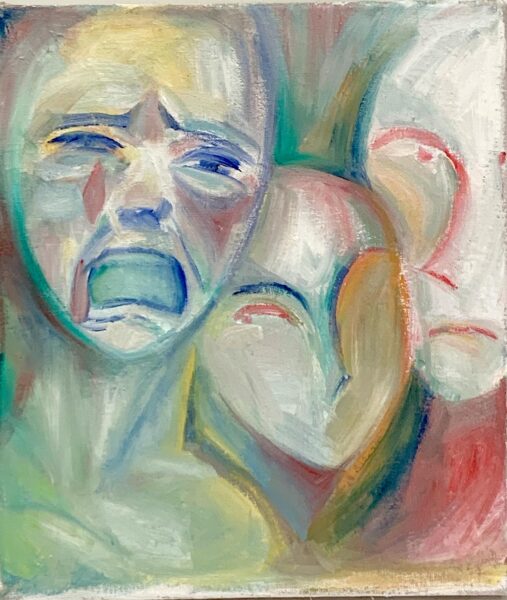
painting with elements of collage
WI State Standards:
- AA Cr11h
Plan: Formulate original concepts by practice, experimentation, and revision. (planning/experimentation) - AA Cr12h
Make: Create works of art that introduce students to media, care of tools, and basic craftsmanship skills.
(skills) - AA Pr10h
Develop meaning: Create s body of work incorporating personal, historical, and contemporary art to communicate one or morepoints of view.
(aesthetics / communication)
Learning objectives
- visual communication drawing
- learning about Expressionism
- planning and sketching
- exploring new medium
Expressionism
Expressionist artists aimed to convey emotional experience and inner feelings rather than objective reality.
It’s characterized by the subjective expression of intense emotions and inner experiences, often through distorted or exaggerated forms and vibrant colors.
Expressionism often overlaps with other major ‘isms’ of the modernist period: with Futurism, Vorticism, Cubism, Surrealism and Dadaism, etc.
Key Characteristics:
- Expressionism emphasizes the artist’s personal feelings and psychological state over objective reality.
- Artists use bold colors, distorted forms, and dynamic compositions to evoke strong emotions and express inner turmoil.
- Realism is abandoned in favor of exaggerating lines, colors, and forms to amplify emotional impact.
- Expressionist works often explore themes of alienation, anxiety, suffering, and the human condition.

Edvard Munch
The Scream, c.1893

Käthe Kollwitz
Woman with Dead Child, 1903

Franz Marc
Fate of the Animals, 1913
Think of a message you want to communicate!
This can be an emotion, a concept, something you are passionate about…
Sketch and research!
You are going to create an art piece using mixed media. This art piece can be a single canvas, or a series of panels (diptych or triptych)
media to use:
- collage – at least 1/3 of the area – using magazine or newspaper cutouts for color and texture fill or for communicating ideas;
- choice of paint – watercolor, tempera, or acrylics
- choice of graphic medium – marker, pen-and-ink, oil pastels, etc.
- any other medium of your choice to experiment
if you plan on more than one piece – they should look like a series – share a common theme, approach, composition, color scheme, etc.
examples:


STEPS
Before you start
Before you start – write a statement of what you want to accomplish:
- What is it that you want to express with your pieces? (statement, emotions, message, etc.)
- What media are you going to use?
- Describe your thought process of how you are planning on using art elements to visually support the message (color scheme, contrasts, composition flow, additional texture, types of shapes, tonal value, etc.)
- Use your sketchbook to draw a series of thumbnails/sketches to develop the concept of your piece
- Search for references
- Create a final sketch, decide on colors, media distribution, etc…
Next
Submit :
- "Before" statement
- sketchbook work
- final sketch
Artwork
Follow your sketches ideas, but feel free to change things as you go.
Start with texture and collage (magazine cutouts) before painting.
After you are done
After you are done – write a description of the finished pieces – (one description for the entire assignment in full sentences):
- Describe the pieces you have made. Why that subject matter?
- Did you modify your initial ideas? If so, why?
- What materials were you using and why in that application?
- How does this artwork represent your skills as an artist?
- Before-and-after statements (2)
- Sketches to show your thought process and project development (sketchbook)
- Final sketch
- Final piece(s)
Collage tips

Dominant color
Some images/photos have a color/colors that dominate over the rest of them.
After you decided on your color scheme – collect magazine cutouts that would fit into the scheme.
Group them.

Collect pieces of the color you want to use. Use variations of colors.

Overlap them to hide the background.
The pieces can be of different sizes and shapes.
They can also support your theme.
You can rip them…… or cut them, or both…


Keep in mind – smaller pieces look more homogeneous.
You can also create color transitions.


 If you are using a newspaper – use it as a background.
You can paint over it, tint it, or use it as a part of your piece.