


Tile Carving
WI State Standards:
- AA Cr10h
Investigate: Engage in critical thinking, problem solving, and research through elements and principles of art and design studio practices and processes.
(aesthetics / problem solving) - AA Cr11h
Plan: Formulate original concepts by practice, experimentation, and revision. (planning/experimentation) - AA Cr12h
Make: Create works of art that introduce students to media, care of tools, and basic craftsmanship skills.
(skills)
Learning objectives
- creative project: planning and executing
- conditioning clay
- following the process
- relief carving
- glazing
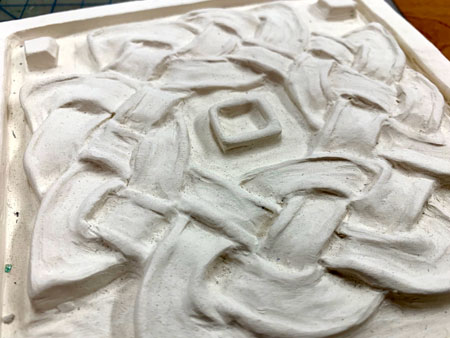
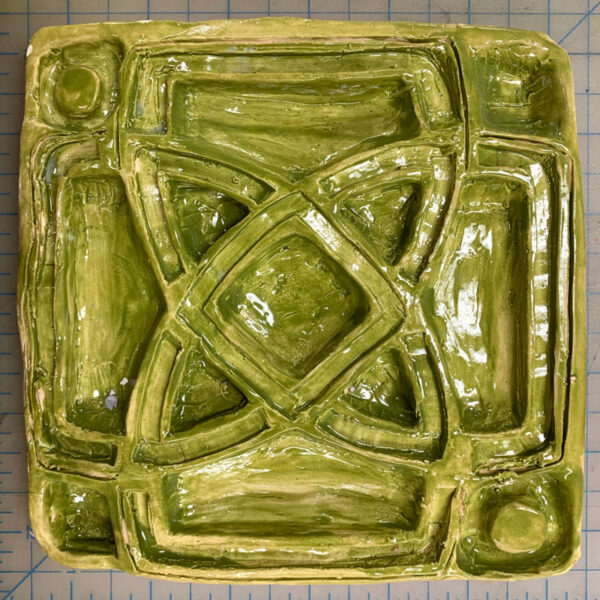
In this project, you’ll create a ceramic tile using sunken relief carving, also called a “sunken relief” or intaglio relief. Instead of having elements that stand out above the surface, your design is carved into a flat clay tile so that the figure is lower than the surrounding plane.
This technique emphasizes lines, shadow, and depth by cutting away clay to create imagery.
You’ll start with a smooth slab of clay, transfer your drawing, and then carve away the background or portions of it to reveal your design. Throughout the process you’ll think about how light and shadow play across your surfaces, and use texture, depth, and contour to bring your composition to life.
The goal is to balance the flatness of the tile with the depth of your carved areas to create a dynamic, tactile piece.
examples:


STEPS
Prepare your clay slab
Roll out a slab of clay about ½ inch thick.
Smooth the surface with a damp sponge so it’s even and clean.
Plan your design
Sketch your idea on paper first. Think of bold shapes and clear lines that will translate well into carved relief.
Keep in mind that your carving will go into the tile, not stick out.
Transfer your drawing
Lightly draw your design on the clay slab with a needle tool, or place your sketch on top and trace it to leave impressions.
Carve the relief
Use loop tools or ribbon tools to carefully remove clay from the background around your design.
Work slowly, carving down to different depths to create contrast.
Keep the main shapes of your design raised above the carved background.
Add texture and details
Use smaller tools, a needle tool, or even found objects to add textures, patterns, or fine lines.
Emphasize areas with shadows and highlights to make your design stand out.
Clean up the surface
Use a damp sponge or soft brush to smooth edges and surfaces.
Be careful not to smear your carved details.
Drying
Let the tile dry slowly and evenly to avoid cracking. Cover loosely with plastic if needed.
Firing and finishing
Once bone dry, the tile can be bisque fired.
After firing, you may glaze, underglaze, or oxide-wash to enhance the carved textures.