


Handling Clay

Clay is an earthy material of fine grained minerals with traces of metal oxides and organic matter.
Pottery can be created without the use of a potter’s wheel. The potter’s wheel did not appear in history until only 4 000 years ago. The main construction methods were pinch and coil methods.
Clay has been used for many things throughout human history: a writing surface, building material, money, storage containers, cooking vessels and serving plates, electronic device parts, ceramic shields or tiles are used on space ships. Ceramics is a major tool for dating cultures in archeology studies.
the three hand-building techniques
pinch
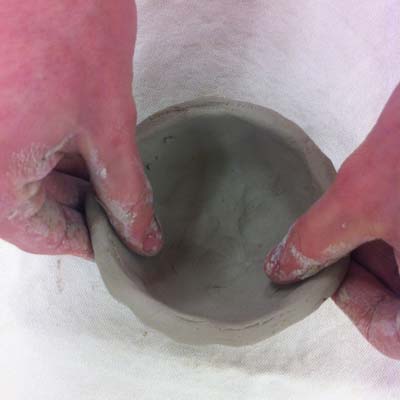
Pinch pots are created by using your hands to shape the clay. Pinch pots are some of the oldest archaeological artifacts found on the planet.
- Begin by forming a smooth ball that fits in your palm (fist size).
- Press the thumb into the center half-way to the bottom.
- Revolve the ball while pressing the walls out evenly with the other hand.
coil

Coil pots are created by pressing coils of clay together.
- Keeping the fingers flat, form clay into sausage shapes.
- Roll them into ropes (coils)
1/4" to 1/2" thick - Coils are pressed together creating a design. Gaps are filled in with small balls of clay.
- Inside of the wall can be smoothed.
- Join the walls & the bottom.
slab
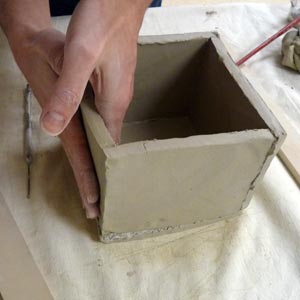
The slab building technique involves rolling out clay to an even thickness – usually 1 cm – then cutting shapes, folding, bending, manipulating and joining together to form a finished object.
- Roll slabs of clay
- Cut out the sides
- Join the sides (score and slip!!)
- Attach the bottom
- Cut out the excess clay from the bottom slab.
Other techniques include:
wheel throwing, relief (high, low, sunken), mold making & slip casting, carving, sculpting, etc.
(remove air bubbles)
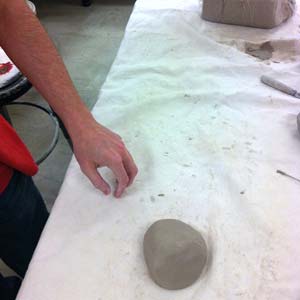
throw
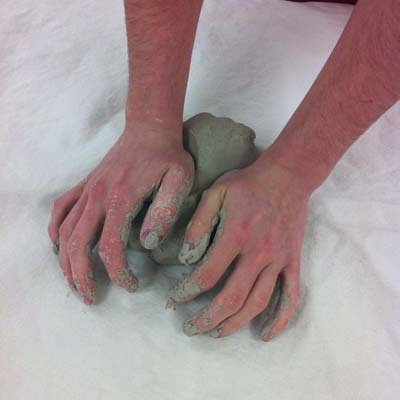
wedge

beat to form a ball
drying stages of clay
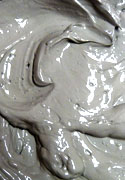
slip
(liquid form of clay)
casting and cementing pieces
plastic
wedging, manipulating, sculpting,
throwing on the wheel…

leather hard
most decorating is done, carving, stamping, building, etc..

bone dry
the driest stage of clay, 0% moisture, ready for bisque firing
firing stages
greenware
unfired pottery that is bone dry (most fragile state)
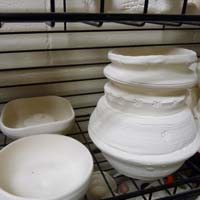
bisqueware (bisque)
unglazed pottery that has been
fired once
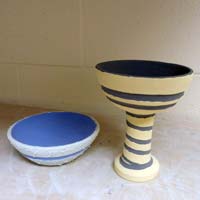
glazeware
ware that has glaze applied and is waiting to be glaze fired
joining pieces
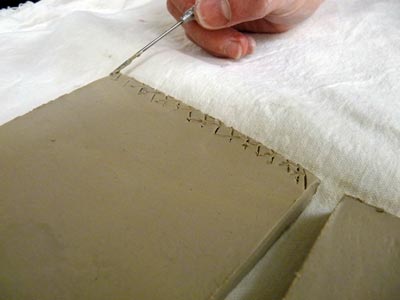
1. score
Roughen both surfaces that you are joining. Use a cross-hatching pattern. Use a needle tool, wedge tool with "teeth", etc.

2. slip
Apply enough slip to both surfaces. Slip will "cement" the pieces together as a glue.
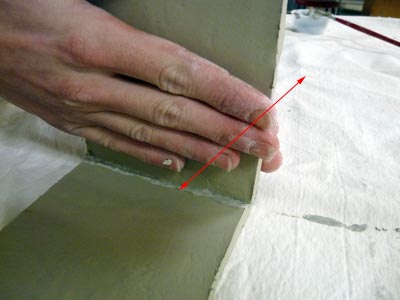
3. rock & press
Rock back and forth while applying some pressure on the piece. This will ensure that the slip will fill in all gaps and removes air pockets.
tools
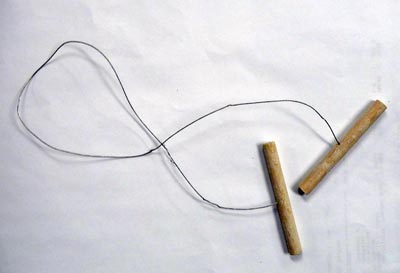
cut-off wire
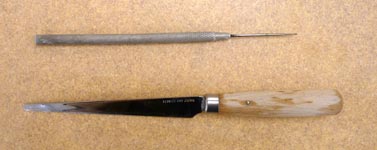
needle tool and fettling knife
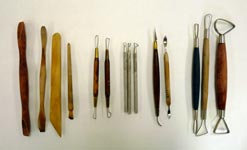
modeling tools

rolling pin and guides
drying
Clay project should dry for at least 7 days before bisque firing to ensure it does not blow up in the kiln.
Moisture (sudden change of water into steam) and air bubbles (trapped air expands) can cause the explosion.
firing
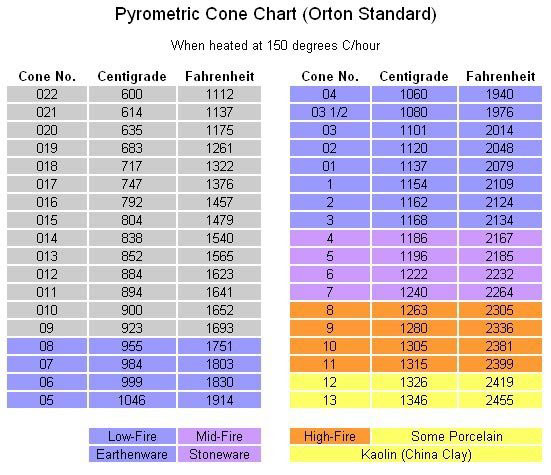
bisque firing
we use low-fire clay
Cone 04
Temperature 1940 F
glaze firing
we use mostly low-fire glazes
Cone 05-06
Temperature 1830-1914 F
- Clay must be thoroughly covered up with a plastic bag to keep it from drying out. This applies to works in process and moist clay.
- Clay dust can be harmful if you are exposed to it for long periods of time, so keep your area clean, clay scraps off the floor and clean with water and sponge.
- Clay should be no thicker than your thumb.
- In order for clay to stick together it must be scored and and slipped together while the clay is moist (plastic) or leather hard.
- Wedge clay to remove air bubbles, achieve uniform consistency, and to line up the clay particles.
- Trapped air can cause clay to explode. So hollow out sculptural forms and put needle holes through enclosed forms for air to escape.
- Don’t glaze the bottom of the piece.
- Wash the piece before glazing.
- Handle your project with two hands at all times. In other words – be careful! – it’s your hard work.
- NEVER handle another person’s work even if it looks cool!